
Inspiration magazine
Natural stone or imitation stone: how do you distinguish when choosing?


Wishing stones are chosen not only by color and shape. For some, the natural beauty of the mineral is important, for others, its history, unusual texture, or personal meaning. But when you have dozens of beautiful stones in front of you, it is not always easy to understand which of them was formed in nature and which was made of glass, plastic, or other materials.
It is especially difficult to tell when an imitation closely resembles the real mineral. Glass can resemble amethyst, a painted stone turquoise, and artificially created beads natural quartz. However, not every bright or unusual stone is a fake.
How to learn to notice the differences? What to look for when buying? And is it possible to determine the naturalness of a stone yourself? Let's consider the signs that will help you make a more informed choice.
What does natural stone mean and what is called imitation?
Natural stone is a mineral or rock that has formed in natural conditions. Amethyst, rose quartz, rock crystal, agate, jasper, citrine and many other well-known minerals are of natural origin.
Each of them is formed under certain geological conditions. Its appearance is influenced by chemical composition, temperature, pressure, impurities and crystal growth characteristics. That is why natural stones can have different shades, veins, inclusions and heterogeneities.
An imitation is a material that is made or used to replicate the appearance of a particular mineral. The most common materials used for this purpose are:
- Glass. It is painted in different colors, shaped, and polished to resemble natural stone.
- Plastic and resin. Beads, decorative stones, and pendants are made from these materials.
- Colored minerals. Natural stone can be treated with dyes to change its color and make it resemble a more expensive or popular rock.
- Pressed materials. Small particles of minerals can be combined with binders and formed into new products.
There is an important nuance here: natural stone does not necessarily have to be untreated. It can be ground, polished, heated, painted or impregnated with special substances. Therefore, when buying, you need to find out not only the origin, but also whether its appearance has been changed.
How to distinguish natural stone from glass
Glass is one of the most common materials used to imitate minerals. It can be transparent, translucent, matte, or richly colored. Using special technologies, glass is given the appearance of amethyst, aquamarine, malachite, turquoise, and other stones.
However, upon close inspection, characteristic differences can sometimes be noticed.
1. Bubbles inside
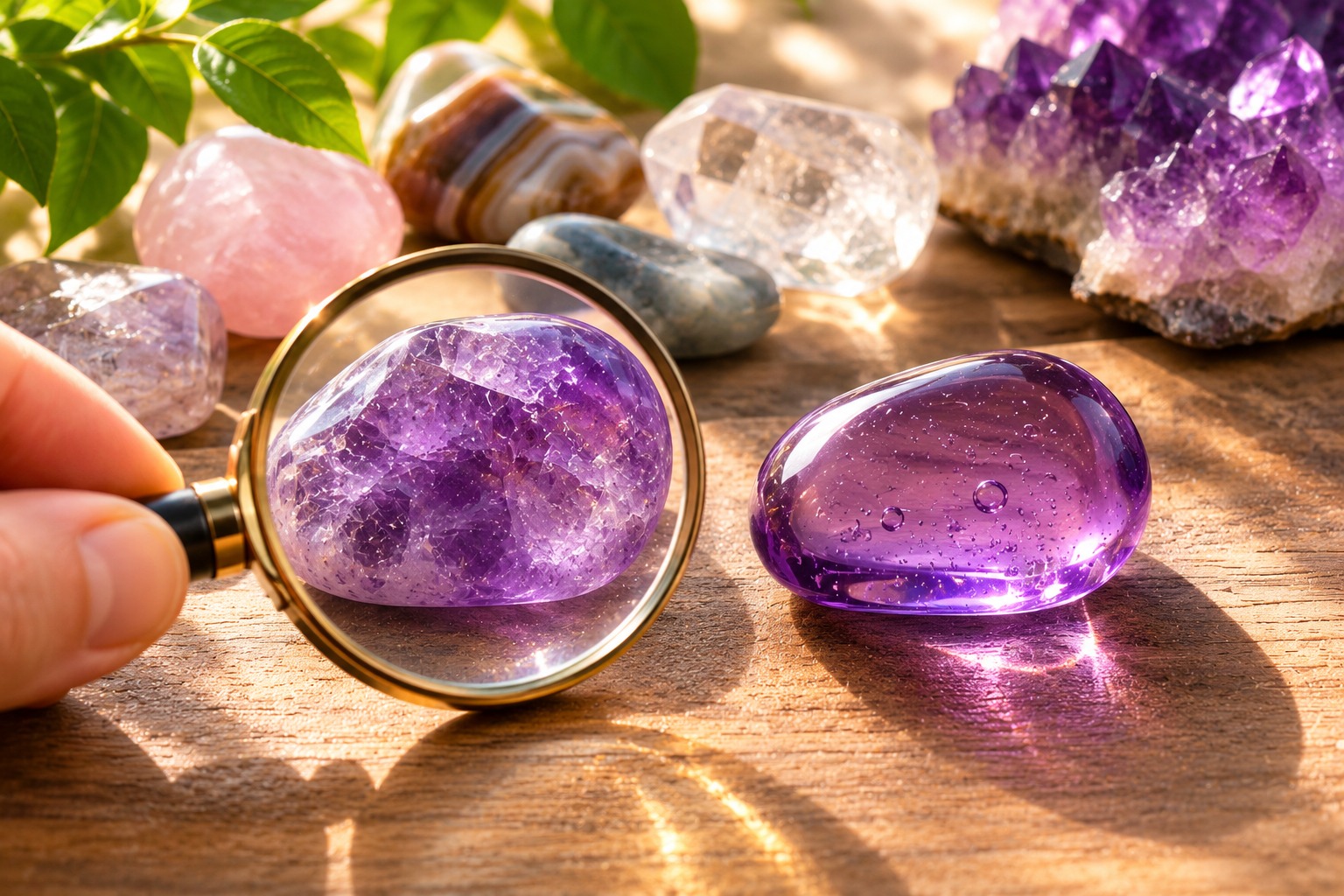
One possible sign of imitation glass is small, round air bubbles within the material. They can be of various sizes and can be found singly or in groups.
Internal inclusions also occur in natural minerals, but their form and origin may be different. For example, cracks, mineral particles, or fluid inclusions can be seen inside quartz.
If you have a magnifying glass, carefully examine the stone in the light. Regular, rounded bubbles may be a reason to examine the material more closely. However, their absence does not prove that you have a natural mineral in front of you.
2. Too correct drawing
Natural texture often has uneven color transitions, veins, and inclusions. In imitation glass, wavy lines, swirls, or an unnaturally regular pattern are sometimes noticeable.
It is especially worth examining stones sold as agate, malachite, or quartz with internal inclusions.
3. Traces of shape and processing
Some glass products are made in molds. They may have fine seam lines, small irregularities, or casting marks.
Natural stones also have traces of grinding after processing, so you need to evaluate the entire surface, not just one detail.
How to understand that a stone is painted
Not every stone with an unusual color is artificial. Natural minerals can be very bright, and their shades can vary even within the same species.
However, some natural stones are additionally dyed to obtain a richer color or to imitate another mineral.
Pay attention to the following signs:
- the color is too concentrated in cracks and recesses;
- there are areas on the surface with noticeably different color intensity;
- Traces of dye may be visible in the holes for stringing beads;
- several stones have an unnaturally uniform, very saturated shade.
For example, agate is often dyed to produce bright blue, green, pink, or purple colors. This treatment does not necessarily mean that the base of the product is made of glass or plastic: the stone may remain natural, but its color has been altered by man.
Therefore, it is more correct to ask the seller not just about naturalness, but also about the presence of dyeing and other processing methods.
Does a perfect shape mean that the stone is fake?
No. Natural stones are often ground, polished, and shaped into a round or other convenient shape. A wish stone can be smooth, symmetrical, and pleasant to the touch, but still be of natural origin.
For example, tumbling is a processing method in which stones are gradually ground and polished, resulting in a smooth surface and rounded edges.
Therefore, you don't need to look exclusively for uneven, untreated minerals. The shape tells about the processing method, but not always about the origin.
It is much more useful to pay attention to the structure, nature of inclusions, information about the material and its processing.
Natural, synthetic or imitation: what's the difference?
These concepts are often confused, although they mean different things.
Natural mineral It is naturally occurring. It can be treated to improve its appearance, but its origin remains natural.
Synthetic mineral grown in a laboratory. It may have virtually the same chemical composition and crystal structure as the corresponding natural mineral. For example, lab-grown amethyst is not glass, but it also does not have a natural geological origin.
Imitation It only reproduces the appearance of a particular stone. This may be done using glass, plastic, resin, or another mineral.
This difference is especially important when buying. If you want to buy a natural wish stone, you need to clarify its origin, and not be limited to the name and photo.
What to look for when choosing popular wish stones
Different minerals have their own characteristics. Knowing their appearance will help you better navigate when buying.
Amethyst
Amethyst is a purple variety of quartz. Its shades can vary from delicate lilac to deep purple.
Natural amethyst may have uneven color transitions, internal inclusions, and small cracks. However, transparency and uniformity of color alone do not allow us to determine the origin of the stone.
Imitation glass sometimes contains rounded bubbles or characteristic swirls inside.
Rose quartz
Natural rose quartz usually has a delicate pink hue and can be translucent or almost opaque.
Its color is not always uniform. Some specimens show lighter and richer areas, natural inclusions, or internal structural features.
Too bright pink stones are worth examining more closely: they may be painted or made of glass.
Rock crystal
Rock crystal — a transparent variety of quartz. It may have natural cracks, internal inclusions, and small transparency features.
Absolute transparency is not proof of artificial origin, just as the presence of inclusions does not guarantee naturalness. Glass products can also be very transparent, so additional signs are needed for accurate identification.
Agate
Agate is a variety of chalcedony. It is often recognized by its stripes, layers, and various color transitions.
The natural pattern of agate can be very distinctive and unusual. However, this mineral is also often dyed, so it is especially important to check whether its color has been altered.
Jasper
Jasper is a natural mineral with a variety of colors and patterns. It can combine red, brown, yellow, green, gray, and other shades.
Its characteristic feature is opacity and often complex, heterogeneous texture. At the same time, it is not possible to reliably determine the type of stone based on the pattern alone.
How to check a stone before buying
Whether you're choosing a wishing stone in a store or ordering it online, don't rush into making a decision. A few simple steps will help avoid misunderstandings.
- Specify the exact name of the mineral. Ask what kind of stone they are selling, rather than just accepting a generic name like «purple crystal.».
- Learn about the origin. Determine whether the stone is natural, lab-grown, or imitation.
- Ask about processing. Has it been painted, heated, impregnated, or coated with a protective compound?
- Look at the photos in different lighting. For online purchases, request additional close-up images of the stone.
- Compare several samples. If all the stones have exactly the same pattern and shade, it is worth clarifying the method of their manufacture.
- Check the seller information. A reliable seller should explain what material they offer and not hide information about the processing.
If it is an expensive mineral and its naturalness is of fundamental importance, the best option would be a professional gemological examination.
Which home tests are best not to use?
You can find a lot of advice on the Internet: scratch the stone with a knife, heat it, put it on fire, check it with vinegar, or even break it to inspect the internal structure.
Such methods should not be used to test wishing stones.
First, you can damage the mineral or its surface. Second, some natural stones have properties similar to artificial materials, so the result will not be unambiguous. Third, heat, acids and mechanical damage can ruin the stone or affect its processing.
Even a magnifying glass doesn't always give a definitive answer. It helps to see details, but identifying some minerals, synthetic analogues, and processing methods requires specialized equipment.
Can natural stone have flaws?
Yes. Natural origin does not mean perfect shape, uniform color, or a complete lack of internal features.
There may be small irregularities on the surface, natural cracks, inclusions of other minerals or differences in color. For many stones, these are normal features of their structure.
That is why two natural stones of the same type can look different. Even if they have the same name, each sample can differ in shade, pattern and degree of transparency.
When choosing, it is important to distinguish between natural features and damage. If the stone has deep cracks, chips, or unstable areas, it is worth clarifying whether these will affect its durability.
How to choose your wishing stone
Choosing a wish stone is a combination of personal preference and practical consideration. Some people like clear rock crystal, some like delicate rose quartz, and some choose agate with unusual natural stripes.
You don't have to look for a stone with the perfect color or shape. Pay attention to the shade, texture, and size that you like. But at the same time, don't forget to check what exactly you are buying.
If natural origin is fundamentally important to you, ask about it directly. Natural, synthetic imitation material are different categories, and the buyer has the right to know which product he is choosing.
A wishing stone can become a personal item that reminds you of a dream, an important goal, or an intention. And a conscious choice will help you appreciate it not only for its external beauty, but also for its true origin and characteristics.